
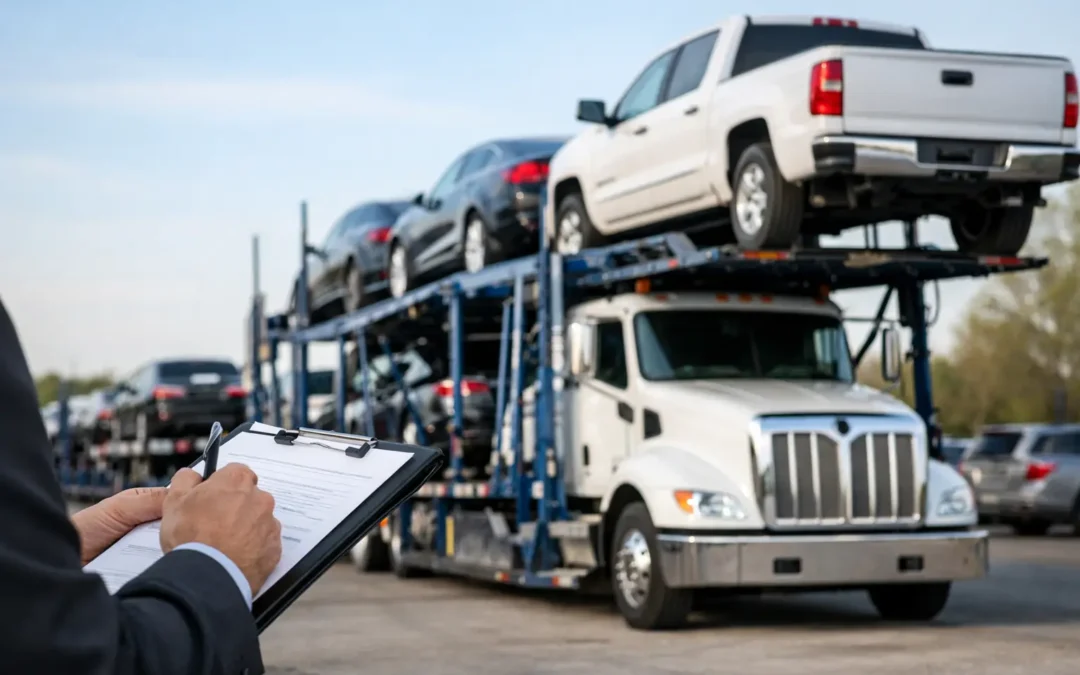
One damaged vehicle can turn a profitable auto transport load into a five-figure claim. That is why the best coverage for auto haulers is not simply the lowest premium or the first policy that produces an insurance certificate. It is a coverage structure built around your authority, the value and volume of vehicles you transport, your trailer setup, and the contracts you must meet to book freight.
Auto hauling has a different loss profile than general freight. A claim may involve several customer vehicles on one trailer, damage during loading or unloading, a chain-reaction highway accident, or a disputed pre-existing condition. Your insurance program needs to respond to the risks you actually face, not just satisfy a minimum filing requirement.
Start With Primary Auto Liability
Primary auto liability is the foundation of an auto hauler insurance program. It pays for bodily injury and property damage you cause to others in a covered accident. For interstate for-hire carriers, federal financial responsibility requirements may begin at $750,000 depending on the operation, but that figure is often not enough to compete for quality freight.
Many brokers, dealerships, auctions, and direct customers require a $1 million combined single limit. Higher limits may make sense for operators hauling through congested metro areas, running multi-car trailers, or working under contracts with stricter insurance language. The right limit depends on your routes, equipment, loss history, and customer requirements, but choosing the federal minimum solely to reduce premium can limit the loads you can accept.
If you operate under your own interstate authority, your insurer must also make the appropriate FMCSA filing, typically a BMC-91X. The MCS-90 endorsement is another federal compliance component that may be required for regulated interstate operations. These filings are not optional paperwork. A cancellation, filing delay, or incorrect policy setup can put authority and revenue at risk.
The Best Coverage for Auto Haulers Includes Cargo Protection
Motor truck cargo coverage protects the vehicles in your care, custody, and control while you transport them. This is where many auto haulers need to look beyond a generic cargo limit. A standard $100,000 cargo limit may sound adequate until you calculate the value of six, eight, or nine late-model vehicles on a single unit.
Review cargo limits in two ways: the total limit per conveyance and any maximum limit per vehicle. If your trailer regularly carries vehicles worth $40,000 to $80,000 each, the per-vehicle sublimit matters just as much as the total policy limit. A policy that pays up to $250,000 in total but caps each vehicle at $25,000 leaves a serious gap.
The valuation method also deserves close attention. Policies may settle losses based on actual cash value, stated value, replacement cost, or a defined valuation schedule. You need to know how the carrier will establish value after a total loss and whether deductibles apply separately to each damaged vehicle or to the occurrence.
Loading and unloading is another critical area. Auto transport losses do not only happen at highway speed. A vehicle can slide off a ramp, strike a deck, sustain undercarriage damage, or be damaged while being repositioned at a dealership or auction. Ask specifically whether loading and unloading are included and whether there are exclusions related to improper securement, unattended vehicles, or mysterious disappearance.
Cargo insurance also does not automatically cover every business dispute. Delayed delivery, diminished value, mechanical breakdown unrelated to a covered event, and pre-existing damage can create conflicts with customers. Maintain thorough inspection records, pickup and delivery photos, bills of lading, and condition reports. Good documentation supports your claim position and helps prevent a routine allegation from becoming an uninsured loss.
Protect the Truck, Trailer, and Your Cash Flow
Physical damage coverage pays for covered loss to your own power unit and trailer, including collision, comprehensive causes of loss, theft, fire, vandalism, and weather events. An auto hauler trailer is specialized equipment. Its value, ramps, hydraulic systems, deck configuration, and replacement lead time should all be considered when selecting limits and deductibles.
Most physical damage claims are settled on an actual cash value basis, subject to the deductible and policy terms. Stated amount coverage may affect how the premium is calculated, but the stated amount is not always a guaranteed payout. Confirm how your equipment is valued and update values as you add equipment or market conditions change.
A higher deductible can reduce premium, but it needs to be a number your business can absorb without delaying repairs. A $10,000 deductible may look attractive on a quote until a tire blowout or low-speed collision sidelines the truck and requires immediate out-of-pocket repairs. For a one- or two-truck operation, that decision is as much about cash flow as insurance cost.
Ask about rental reimbursement, towing, and downtime-related options where available. These coverages vary by carrier and are not a substitute for reserves, but they can help when a covered loss puts equipment out of service. The main goal is simple: get the truck and trailer repaired and back into revenue service without creating a financial emergency.
Add Coverage Based on How You Operate
There is no single policy package that fits every carrier. The best program changes based on your authority, equipment ownership, contracts, and whether you operate independently or under another carrier’s authority.
For example, an owner-operator permanently leased to a motor carrier may need non-trucking liability, often called bobtail coverage, for personal or non-dispatch use. It does not replace the carrier’s primary liability coverage and usually does not protect you while you are actively hauling under dispatch.
If you pull trailers you do not own, trailer interchange coverage may be necessary when a written interchange agreement makes you responsible for physical damage to that equipment. General liability can address certain non-driving business exposures, such as premises or operations liability, but it does not replace motor truck cargo or primary auto liability. Workers’ compensation, occupational accident, and cyber protections may also be relevant depending on your business structure and employee exposure.
A complete discussion with a trucking-focused broker should cover at least these operational details:
- Your operating authority, interstate or intrastate radius, and states of operation
- The number of units, trailer types, VIN values, and equipment ownership structure
- Typical vehicle values, maximum load value, and whether you haul dealer, auction, private-party, or specialty vehicles
- Driver experience, MVRs, prior losses, and safety controls such as cameras, ELDs, and securement procedures
- Contractual insurance requirements from brokers, dealerships, auctions, and shippers
These details drive underwriting. They also help avoid a policy that looks acceptable on a certificate but fails when a loss occurs.
Do Not Confuse a Certificate With Coverage
Customers will often ask for a certificate of insurance before tendering a load. Fast certificate service matters, especially when a dealership needs proof before releasing vehicles. But a certificate is evidence of insurance, not a rewrite of the policy.
Before accepting contract language, review additional insured requirements, waiver of subrogation requests, cargo limits, deductible responsibilities, and any requirement to provide notice of cancellation. Some requests are routine. Others can create obligations that need underwriting approval or may not be available under the policy.
This is especially important for new ventures. First-year carriers often face higher premiums, tighter underwriting, and stricter payment terms because they do not yet have a proven operating history. The answer is not to buy inadequate limits. It is to present a clean underwriting file with accurate driver information, equipment details, safety procedures, and realistic operating territory.
Build Coverage Around the Load You Want Next
The right auto hauler policy should support the business you are building, not just the load you hauled last month. If you plan to move from lower-value auction vehicles into dealer deliveries, enclosed transport, or higher-value specialty units, review cargo limits before the first higher-value load is on the trailer.
Monarca Trucking Insurance Services works with trucking operators to match coverage, filings, and certificate requirements to the realities of the operation. A careful review before binding can prevent costly coverage gaps after a claim or a rejected load.
Keep your schedule of vehicles, trailer values, driver roster, and customer requirements current. When your insurance reflects the way you actually haul, you can take the next load knowing your protection is built for the work, not merely for the paperwork.